#22 TATWTD — THE DELICACY OF LANGUAGE
It doesn’t take much to make an enemy. I’m not aware of having one, but if we are able to “entertain angels unaware,” as Christian scripture suggests, then it is likely that we are able to offend with equal ignorance. I came close, I think, by openly disliking the man presently called POTUS, yet all the while caring dearly for a friend seemingly satisfied with the present state of things under Mr. Trump’s leadership. Just in time, I think, we shifted our conversations to other topics and held onto friendship.
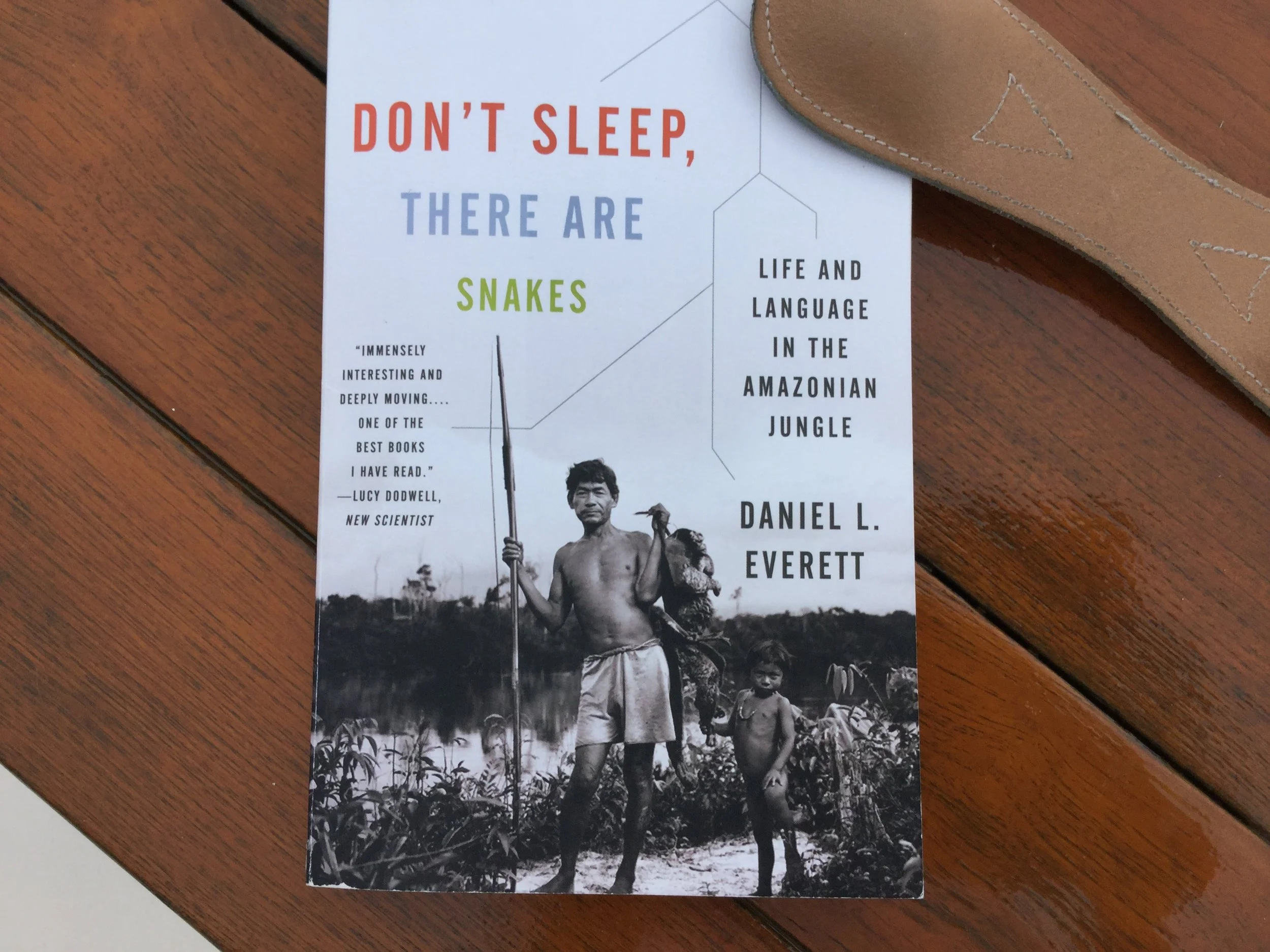
I recently finished reading, Don’t Sleep, There are Snakes, by linguist, Daniel L. Everett. For thirty years, he worked to translate the language of the Piraha (pee-da-HAN), an Amazonian Indian tribe. In this blog I mean to introduce the Piraha words for Friend and Enemy but first, get this . . .
The Piraha people—numbering about 400, and considered among the happiest on earth—have no words for counting or numbers. They don’t answer the question, “How many children do you have?” with a number. Why should they have a number for that which they know by immediate experience? They have no direct words for color.
You ask, “What color is that (you see green)?”
“That is not ripe yet,” comes the answer.
A brown shirt’s color?
“It is Maici River in the rainy season.” So, look to the river in the rainy season and you will have the color you call brown.
No qualifiers needed. One doesn’t find all, each, or either.
“Hiaitiihi hi ogixaagao pio kaobii” “The bigness of the people went swimming.”
The Piraha language has nine consonants —p,t,k,s,h,b,g, and three vowels—i,a,o. Women use only eight; for them, the h replaces the men’s s.
Oh, right, throw in a glottal stop—x. Appreciate that the language is tonal, (each vowel in every word bears a different tone), accented (my iPad won’t do it), and that the length of syllables differentiate meanings from identical spellings. Think of how the word “Great” is often accented in English among Americans: “Trump won. Great!” “Trump won . . .Great.” Like the Piraha language, tone can serve an immediate experience.
Pirahas hum, sing, whistle, yell, and speak their language. And this: the men whistle conversation when they hunt in the jungle. Go ahead male readers, whistle the words to a Robert Frost poem.
And for grammar snobs — no past or future tense, no recursion; that is, no relative clauses, ever. You will not find a phrase within a phrase. Sorry, Chomsky. Now, concerning the words for Enemy and Friend.
One day, while learning new words, Daniel asked his friend, Kohoi, “When you like someone very much, what do you call him?”
“Bagiai,” Kohoi responded.
“You are my bagiai,” Daniel responded, testing.
Kohoi laughed and laughed.
“What, you don’t like me?” Daniel was baffled.
“I do like you,” he said, laughing all the while. “You are my bagiai, but there are bagiai and we don’t like them.”
To help Daniel hear that he was saying “enemy,” Kohoi slowly whistled the word.
“Ah! Daniel got it. The word for Friend — bagiai—had a single high tone on the last a: Ai
The word for Enemy, exact in letters, had two high tones, one on each a: bA-gi-Ai.
So, think I, as we Americans weather a season of seemingly great political stress, we may wish to care about the tone of voice, the length of a syllable, the place of an accent. Ah, yes, what a difference these things can make between friends.