#12 A WORD SERIES: CLIP
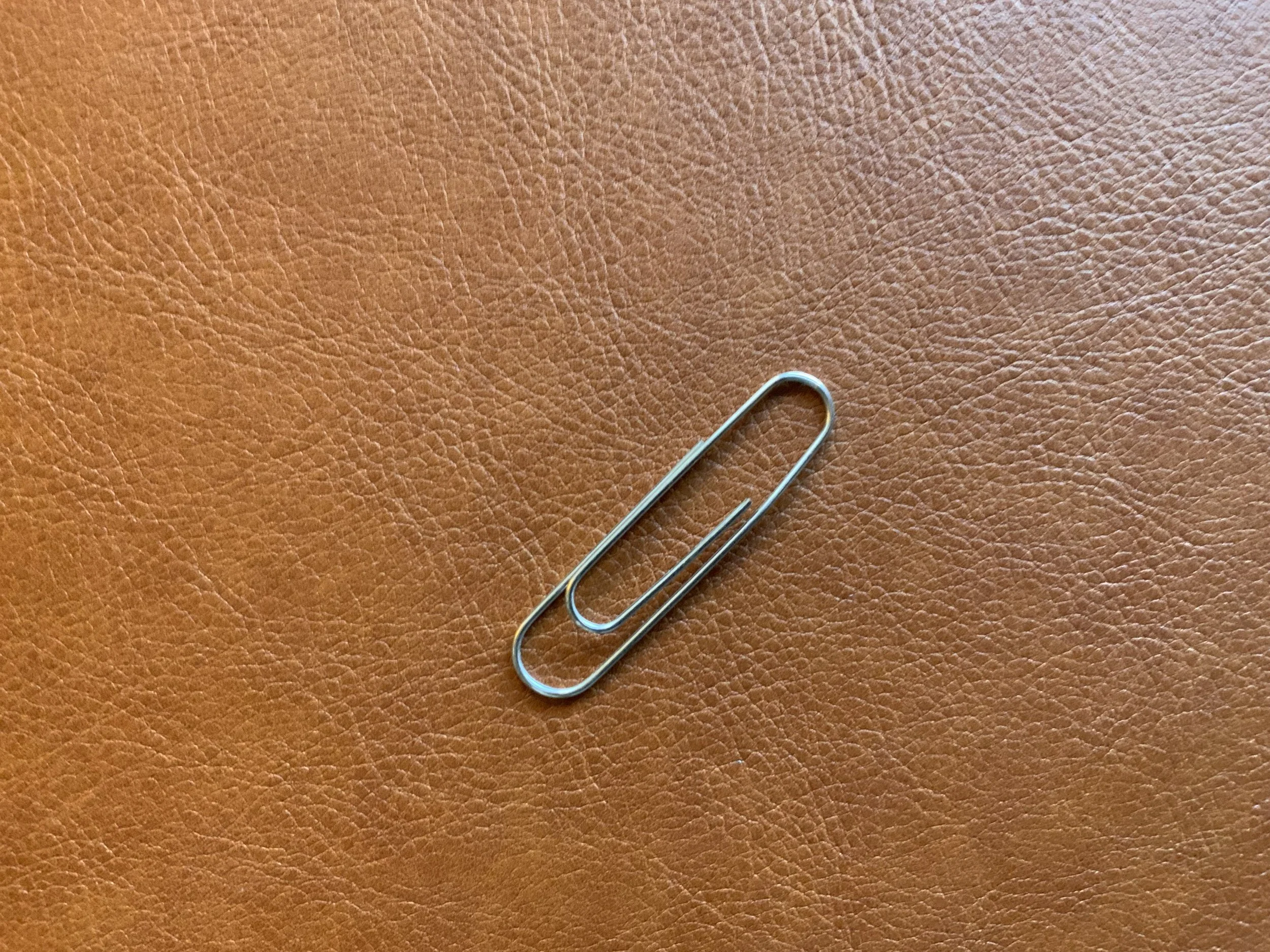
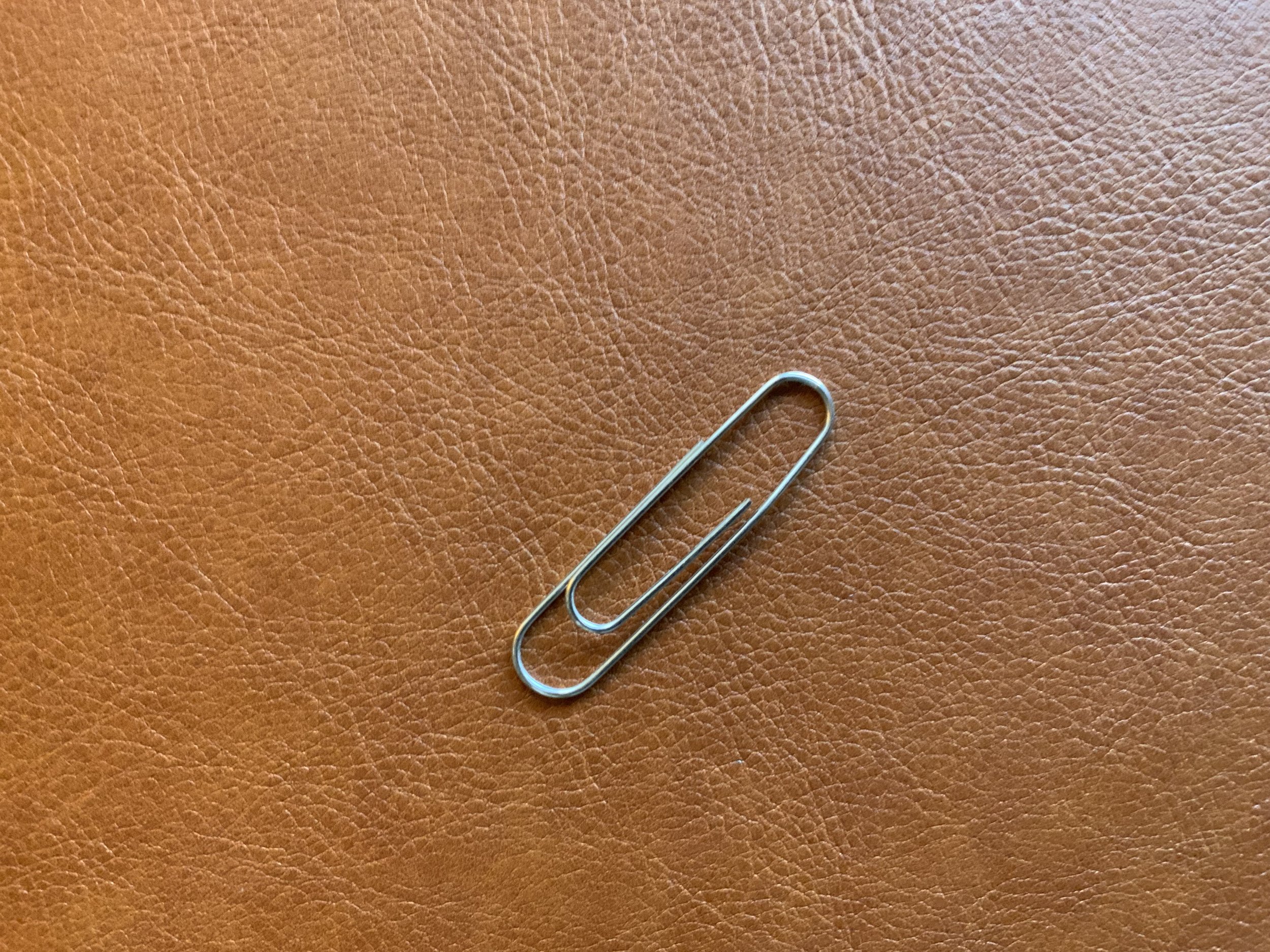
“OH! Look what I found,” I said to my friend. “A paperclip.” Right there, on the carpeted corridor floor adjacent to the gym where women gather each Tuesday and Thursday mornings for Strength Training.
Barbara and I had finished three rotations of arm exercises with weights and were on the second of three challenges to our legs. We had finished with squats while holding kettle bells, and would do calf/toe lifts with weights after the Monster Walk which had us in the long hallway where I found the paperclip.
It’s not a pretty thing to see the Monster Walk executed, but it is good for the gluts, hamstring muscles, the quadriceps femoris, and a whole bunch of other stuff at the front of thighs, so down we pressed into a deep squat, and held it while we crab-walked along the wall until those squatted wide side steps made us cry that our shells were cracking. That’s when we lift up, lean against the wall, complain, and take a short break before the monster walk resumes.
That’s when I saw the paperclip on the carpet; when my head was down in a great complaint. I hadn’t yet pushed up to a standing position.
“Oh, look,” I said. “A paperclip.” I picked it up and clipped it onto the hem of my shirtsleeve. Barbara looked a bit baffled. So I explained.
Since the 1970s, whenever I find a paperclip, I require myself to write. Anything. Something. You are now reading what the corridor clip called for—an investigation of the word: “Clip.”
Without even cracking the OED, just from my ten-pound Random House Dictionary, I’ve found twenty-one definitions of the word. A “clip” is primarily about cutting, fastening, speed, media, and hitting. It can be a noun or a verb. It’s part of a horseshoe, a foul in football. A clip can curtail, or speaks rapidly. To ‘be clipped’ is to be swindled, and horses clip-clop. I got hooked (which a clip does) on the seventh definition: “Archaic. Ofris ‘kleppa’ From Old Frisian: “an embrace or hug.” How archaic, I wondered.
The question led me to Rome’s first century notice of the Germanic tribe dwelling at the edge of the North Sea; to those people who lived in artificial mounds, Terpen, located along the coast between the Rhine and Weser rivers; from a touch of South Denmark, through the Netherlands, and into NW Germany—a territory then known as Frisia. People with a common language and common purposes.
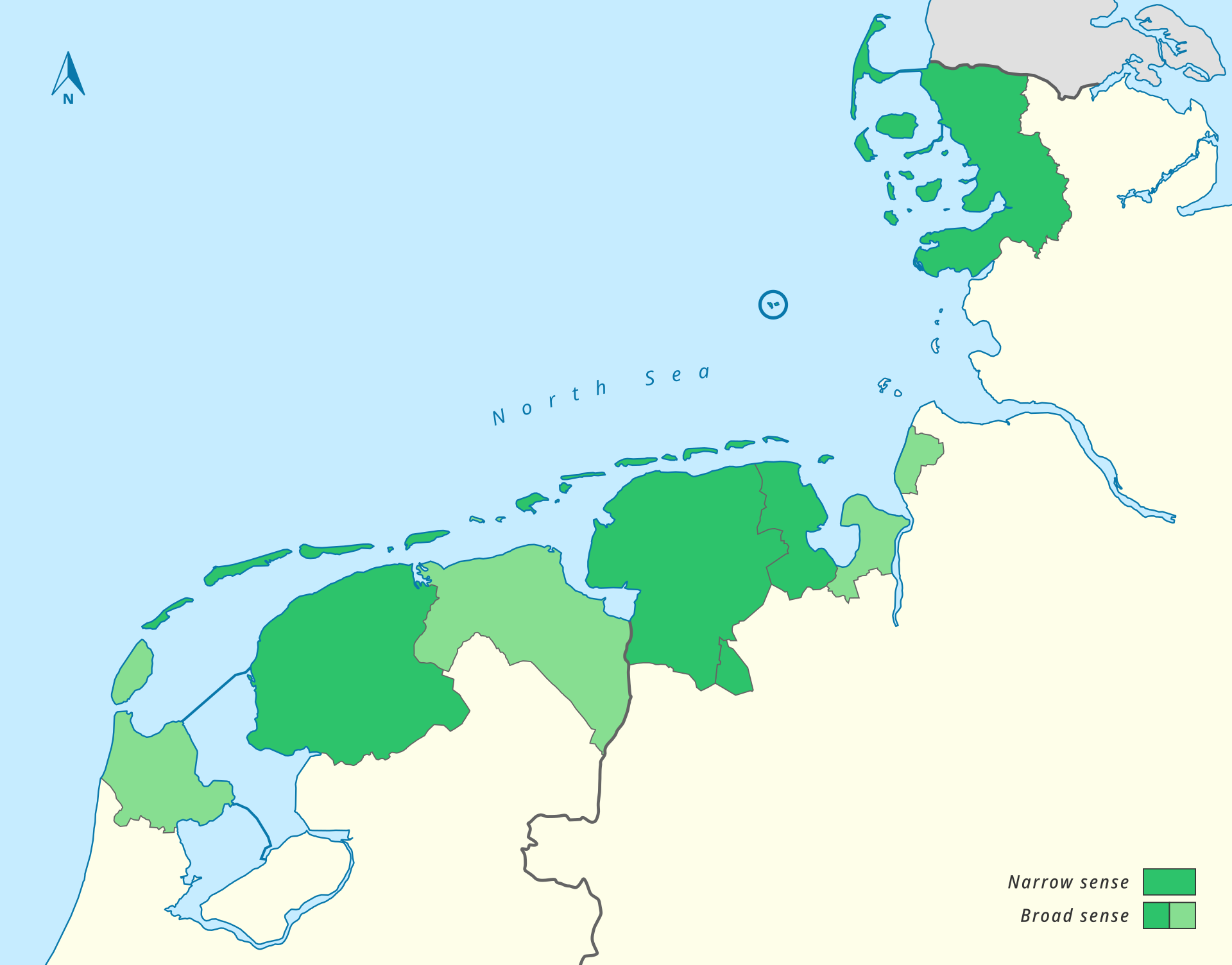
The name, Frisia, may have come from Vulgar Latin, meaning to cut or to clip. These were people who ‘clipped’ the land, digging ditches and dykes to drain the wet marshlands.
In his National History, 77C.E., Pliney the Elder wrote,
[In Frisia] a wretched race is found, inhabiting either the more elevated spots of land, or else eminences artificially constructed, and of a height to which they know by experience that the highest tides will never reach. Here they pitch their cabins.
They refused to be subjugated (this wretched race), but paid taxes to Rome with cowhide. They were excellent agriculturalists as well as sea-going traders. Interestingly, I’m writing this Saturday on a day some Americans are declaring a similar sentiment. Paying taxes, but rejecting possible subjugation.
Between 600-750CE, the Frisians were the dominant merchants of Northern Europe. The famous Frisian king, Radbod, a worshipper of the Germanic pagan gods, Thor and Odin, refused Christian baptism saying he would rather spend eternity in Hell with his ancestors than Heaven with his enemies. I have no idea if he got his wish.
Around 800CE, the Franks conquered the Frisians, and by the late Middle Ages, subjugation and internal feuding led to a three-way political spilt among these coastal countrymen. West Frisia in the Netherlands (West Frisian is still spoken by about 400,000 people in the Dutch province of Friesland). East Frisia in lower Saxony, Germany, and North Frisia in Schleswig-Holstein, Germany’s northernmost state (yes, the Holstein cows can be found there).
Here’s what caught my attention about Frisia. In the 11th, 12th, and 14th centuries, severe storms changed the coastline, thus changing where people lived. Subjugation and political fragmentation changed how people lived. What was known as “Frisia Freedom” was curtailed by Feudalization. Let me make it this easy.
My word: Paperclip. A paperclip holds things together. It secures. It keeps parts that should be together, well, together. Like a hug. It is very much like Kleppa, the archaic Old Frisian word for “embrace or hug.” I will venture to say my country could use one.
SCROLL DOWN TO LEAVE COMMENTS FOR BARB