
#83 PUPPY - EPIGENETICS
Scooter settled on my desk which he doesn’t do much anymore, but I had half an apple at my computer, and he loves apple. We shared it.

SCOOTER SUBLIME GUARDS THE APPLE
“Are you writing about me?”
“I am,” I said.
“Are you going to use that word?” he asked, swiveling his nose to the computer screen. The word was Epigenetics.
“I am,” I said.
“Say it,” he said.
I said it.
“Is it something the Vet is going to do to me?”
“It is not.”
“Something I ate? You know the little hippo, Fiona, ate a child’s knitted hat and she died. Better be careful what you feed me,” he said, chewing.
“Epigenetics is not eatable.”
As Scooter jumped off the desk, he said, “You use that word in a blog and you’re in trouble with your readers, Mom.”
I’m taking the risk. “You’re the one in trouble.”
Epigenetics (noun), is the scientific field that attempts to explain how lifestyle can affect genes. The Greek preface “epi” means “on top of, or in addition to.”
I’m not a scientist, but I think I’ve got this right. Chemical tags, and other stuff I don’t understand, sit “on top of” our DNA and manage genetic activity. These tags epigenetically trigger changes like an Off-On Dimmer switch controls a lamp. Genes can be turned up, down, off, on all without changing the DNA sequence. Cortisol is a major factor. It happens in living things with brains.
I’m not interested in how genes determine eye or hair color, or skeletal growth. For Scooter’s sake, I’m interested in recent research that shows how epigenetic activity is linked to stress, fear, and anxiety; how a mother’s stress affects her offspring.
Scooter’s and my #62 PUPPY blog post began like this (find it at pinewordworks.com)
“I need to tell you something, Scooter. Before we bought you . . .”
“You bought me?”
“Stop it! Yes. People buy dogs.”
It didn’t take long to coax him from under the bed.
“I’m getting close to my fourth birthday,” said Scooter. “What’s more to say?”
“I’m going to say that we ought not to have purchased you. I’ve learned a lot.”
That #62 chat occurred three years ago but it came to mind recently when without reason Scooter ambushed an approaching dog. What makes a happy dog situationally fierce? Could it be epigenetically caused?
From the Wiley Online Library (thank you Chat GPT) I read: “Direct epigenetic inheritance is where a specific stress-induced DNA mark on a mother dog’s egg is passed unchanged to her puppies . . . researchers have documented clear ways a stressed mother shapes her puppies’ stress systems and gene expression before birth and in early life.”
In that older blog, I knew that Scooter was likely whelped from an undernourished bitch that “will be or had been impregnated every cycle, will live, or has lived, in a small, filthy wire cage stacked with other small wire cages, denied kindness, and will be, or has been, destroyed after however many years she is or was no longer a profitable ‘unit of production.’” At the time, his puppy-mill had over ninety caged breeding bitches.
If Scooter’s Missouri birth was a typical puppy mill occurrence, he was taken from that small wire cage at who knows what age; sometimes as early as four weeks, enabling the bitch to get to her next fertile cycle earlier.
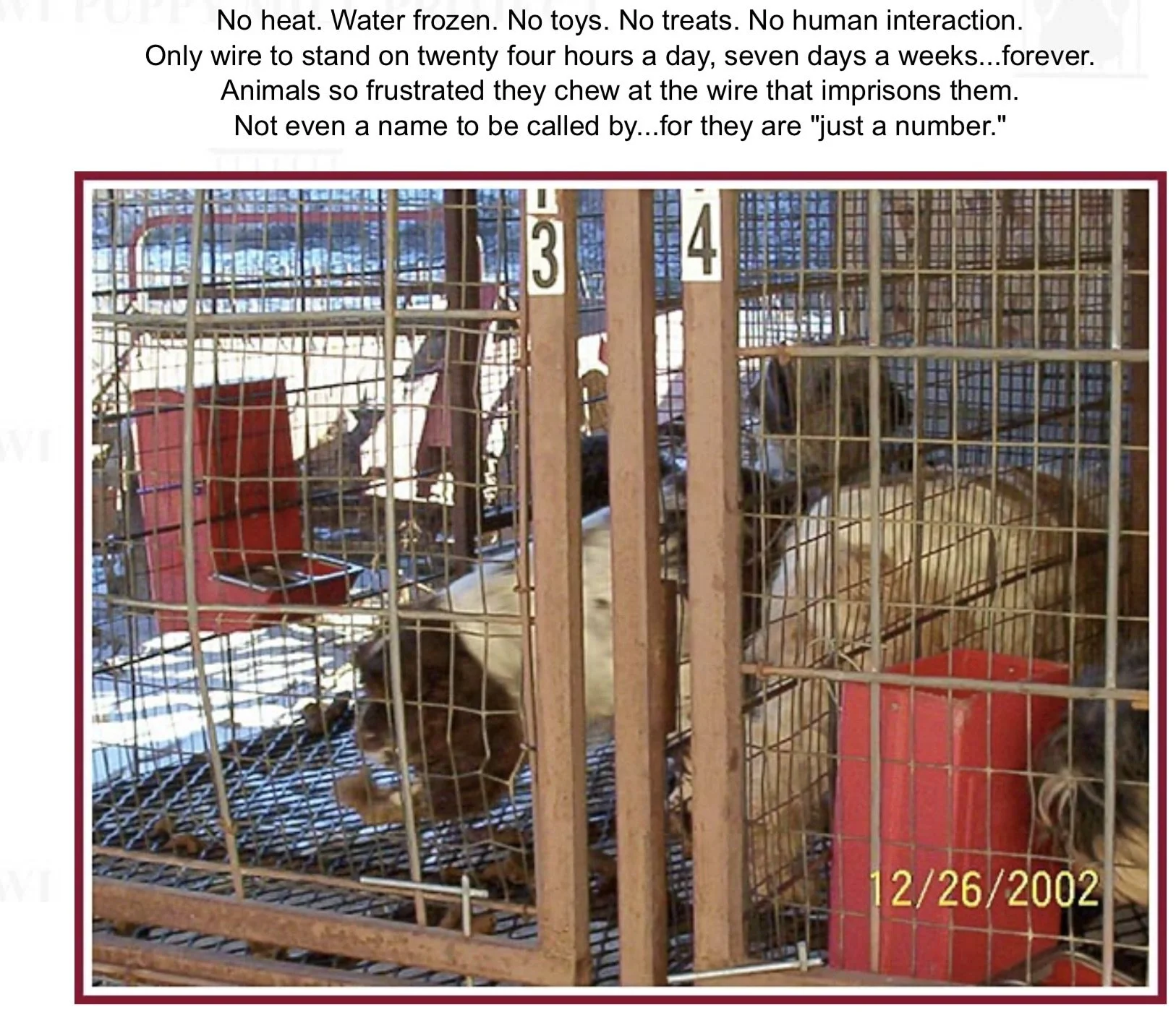
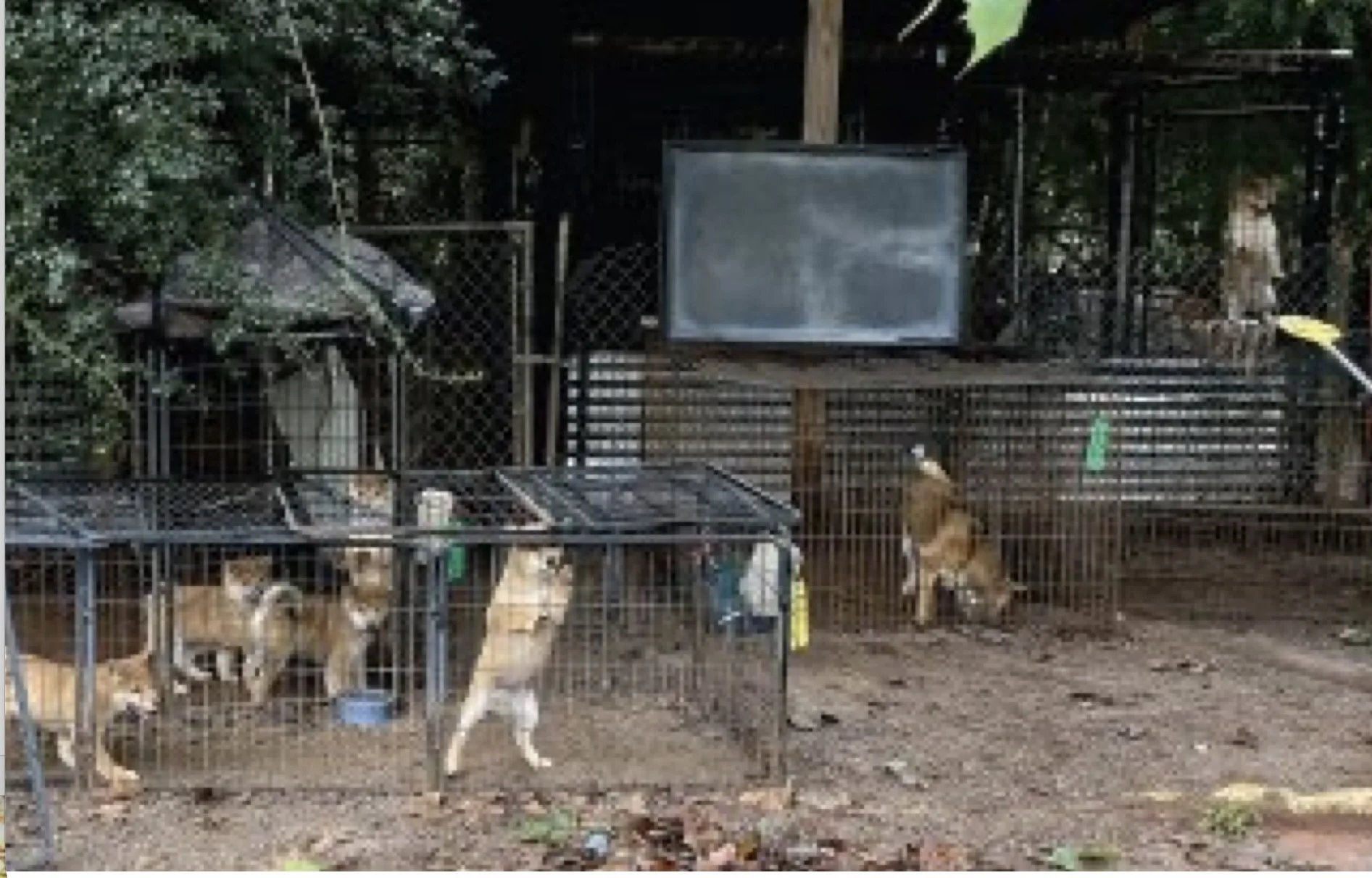
“UNITS OF PRODUCTION”
He was then transported from Missouri to a particular Iowa Puppy Distributor who in a recent raid was reported to have more than two hundred caged pups on hand to, ah, distribute. At some point, at some age before his eleventh week, the distributor handed Scooter to an Iowa Puppy Transporter who placed him in a van

for a trip of who knows how many days, through who knows how many states, with who knows how much filth and neglect (dog transport mistreatment is well documented), before he was dropped off (with Giardia) and externally cleaned up at a Puyallup puppy store where eleven days and a few thousand dollars later, Scooter, and his genealogy certificate, came home with us.
“A study published in late 2022 examined 383 eight-week-old puppies from 12 commercial breeding kennels before ground transport, and about 48 hours after arriving at a distributor. Researchers from Purdue Canine Welfare Research Group found that. . . post-transport puppies showed higher stress hormone metabolites . . . less exploration, more escape attempts, and more seeking of human contact—suggesting acute distress and coping behavior.”
I picture the epigenetic dimmer switch in Scooter’s abused mother’s eggs crazy out of control on cortisol, blinking on and off in his fetal DNA like a kangaroo on speed, and OMG, once born, Scooter’s own responses to constant inhumane treatment. Was there ever a day before the November evening we bought him when he felt safe?
I can’t be more sorry that Scooter initiated a dog fight during which even a human was knocked off balance. Seriously, I can’t be more sorry. However, that he did, led me to question why this delightful doodle of ours has a fighter’s default. That he did, led me to the word Scooter warned against my using: Epigenetics.
The National Institutes of Health did epigenetic studies of Holocaust offspring, of pregnant women in the severe Dutch famine in ’45, and of infants born after 9/11. In all cases, trauma “left lasting epigenetic signatures in exposed children.”
I wonder about pregnant women and children in American inner cities where fear is worn 24-hours a day. Here’s what we know: early life adversity screws up stress responses, social bonding, emotional regulation, brain and neurobehavioral development.
From Translational Psychiatry (vol.6): Exposure to adverse rearing environments including institutional deprivation and severe childhood abuse is associated with an increased risk for mental and physical health problems across the lifespan. . . .epigenetic processes may be involved.
And about dogs. I read that “stress-induced DNA mark on a mother dog’s egg is passed unchanged to her puppies by placental cortisol exposure, by how the mother’s lack of safety or repeated breeding can disrupt how a mother dog tends or comforts her litter.
“Research on dogs with early-life adversity, such as neglect, malnourishment, or early separation has found differences in DNA methylation on stress and bonding related genes, and altered cortisol responses to separation (such as noisy or unstable nurseries) are widely linked to heightened reactivity and fear.”
I’m thinking about Scooter’s experience between conception and November 8, 2019 when, finally, at eleven weeks he felt affection. It isn’t destiny, the effects of epigenetic activity, the tags are reversable, but it takes work.
I called Scooter to me.
“Hey Buddie, what would you think about a canine behavioralist?”
“Is it eatable?” he asked.